POS for pizzerias
Published by KwickPOS, a restaurant POS company. We include KwickPOS in comparisons and say so when we do. How we handle this.
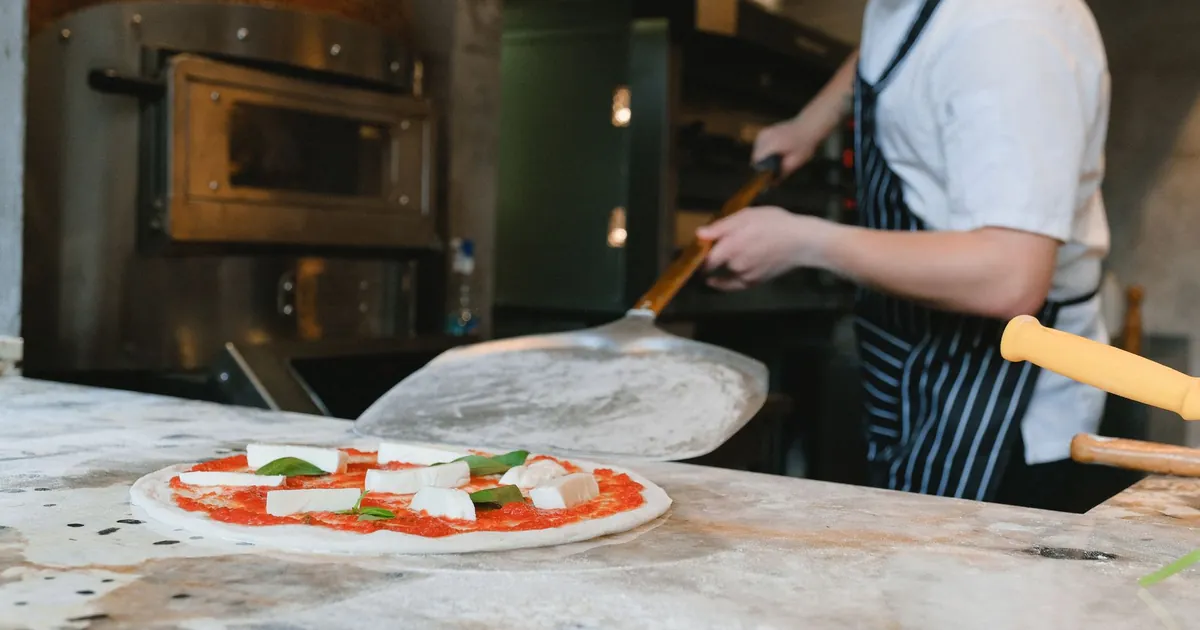
A pizzeria needs a POS that prices toppings by size and by half, prints half-and-half tickets the make line can't misread, knows your delivery zones and fees, dispatches drivers, and takes online and phone orders straight into the kitchen. If you sell by the slice, add slice counts. Test half-and-half pricing and a delivery order in every demo.
A single pizza order can combine a size, a crust, a sauce, a dozen toppings split by halves, a delivery address that has to fall inside your zone, and a driver who needs to know when it's ready. Most POS systems are built around "item plus a few modifiers", which works for a burger and breaks for pizza. This guide covers what a pizzeria POS has to do and what to test before you sign.
Toppings: placement and size-based pricing
- Placement. Every topping needs whole, left half and right half, plus "none" to remove a default. Some shops also want quarters and an "extra" option.
- Fast entry. A pizza picture on the order screen where the cashier taps a half and then a topping is faster than nested text menus.
- Price by size. Extra cheese on a 10-inch should cost less than on an 18-inch, and the price should change automatically if the guest changes size mid-order.
- Specialty defaults. A specialty pie should load its toppings, and the guest should be able to take one off. Decide whether removing a topping lowers the price.
A shop charges $1.50 per topping on a 10-inch, $2.00 on a 14-inch and $2.50 on an 18-inch. A topping on one half costs half that: $0.75, $1.00 or $1.25.
Half-and-half: the math and the ticket
Half-and-half is a common request, and it is where a general-purpose POS is most likely to struggle, so test it first. Each half should behave like its own pizza with its own toppings. You choose the pricing rule, and the POS should support yours:
- Charge the higher of the two specialty prices for the whole pie, with extra toppings at half-pie rates; or
- Charge a flat half-and-half upcharge.
The kitchen ticket has to be unambiguous. "L: Pepperoni / R: Veggie, add mushroom R" can be read in a second. "Large pizza with pepperoni, mushroom, olive, pepper, onion" will be made wrong. In the demo, ring up a large half pepperoni, half veggie with mushrooms on the veggie side, and look at the printed ticket.
Selling by the slice
If you sell slices at a counter, the POS should let staff enter how many slices of each kind are on the rack and count them down as they sell. Slice sales by hour also show which pies to bake for the next lunch rush and which ones end up in the trash.
Delivery zones and fees
| Zone method | How it works | Trade-off |
|---|---|---|
| ZIP codes | You list the ZIP codes you deliver to and give each a fee and time estimate. | Quick to set up, but a ZIP code can be large, so edges are imprecise. |
| Radius or map area | You draw your delivery area on a map, with fee tiers by distance. | More accurate at the edges, and needed for tiered fees by distance. |
The address should be checked against your zones while the order is being taken, so staff can offer pickup instead of promising a delivery you don't make. The delivery fee should be added automatically from the zone.
Drivers and dispatch
- A dispatch screen showing orders ready to go, drivers available, and how long each order has waited.
- Grouping two or three nearby orders onto one run.
- Driver cash-out at the end of the shift: cash collected, tips, and any delivery fees paid to drivers.
- Text messages to the customer when the order leaves.
If you use your own drivers, ask whether the POS includes dispatch or needs a separate app, and what that app costs.
Online and phone orders
If you take orders by phone and online, there are two different setups:
- Ordering from your own website, built into the POS. Orders go straight to the kitchen with the same topping rules and delivery zones. You pay card processing on these orders, but not a marketplace commission.
- Marketplace apps such as DoorDash, Uber Eats and Grubhub. They bring new customers but charge a commission on each order, set out on each company's own merchant pricing page. Ask whether their orders flow into your POS automatically or arrive on a separate tablet that someone has to retype from.
Also check menu sync (a topping you run out of comes off every channel at once) and order throttling (online ordering slows or pauses when the kitchen is slammed).
Marketplace commissions
| Marketplace | Commission on delivery orders | Commission on pickup orders |
|---|---|---|
| DoorDash | 15%, 25% or 30%, by plan | 6% on every plan |
| Uber Eats | 20%, 25% or 30%, by plan (the lowest plan is 15% in some cities) | 7% with validated in-store pricing, otherwise 10% |
| Grubhub | A marketing commission of 5% to 20%, by plan, plus a 10% delivery fee when Grubhub delivers | Not stated on that page |
Figures are from each company's own US merchant pricing page, checked October 1, 2026. They change, and card processing fees are charged on top; check the current page before you sign up.
Size and half-pizza pricing in practice
Ask each vendor to show how size pricing applies to toppings. Toast's documentation, for example, describes setting size prices for a menu item and how that carries through to its modifiers. If a system can only handle halves by duplicating every topping as "left" and "right" items, your menu becomes much harder to maintain.
The make line and the oven
The make station, the oven and the cut-and-box station each need a different view of the same order. Kitchen display screens can show each station only its part. Printers are cheaper and survive heat well. Either way, the ticket should show the order type (delivery, pickup, dine-in) and the promised time.
Loyalty
Pizza is a repeat purchase. A simple points or "every tenth pizza" program built into the POS, tied to the customer's phone number, works for phone, counter and online orders alike. Ask whether online orders earn points automatically.
What to bring to the demo
- Your size and topping price chart.
- Your specialty pies and their default toppings.
- A map of your delivery area and your delivery fees.
- How many drivers you run on a Friday night.
Then run the tests in how to choose a restaurant POS, plus one phone order for delivery to an address just outside your zone.
Common questions
How should a POS price half-and-half pizzas?
Either the higher of the two specialty prices with half-rate extra toppings, or a flat upcharge. Choose your rule and make the vendor show it.
ZIP codes or a map for delivery zones?
ZIP codes are quicker to set up; a drawn map area is more accurate at the edges and supports fees by distance.
Do I need my own online ordering if I'm on delivery apps?
Ordering from your own website avoids marketplace commissions on repeat customers. Many shops use both: apps to reach new customers and their own site for regulars.
Sources
- Size pricing, Toast. Checked October 1, 2026.
- Pricing for restaurants, DoorDash. Checked October 1, 2026.
- Uber Eats pricing, Uber Eats. Checked October 1, 2026.
- What fees does Grubhub charge restaurants?, Grubhub. Checked October 1, 2026.